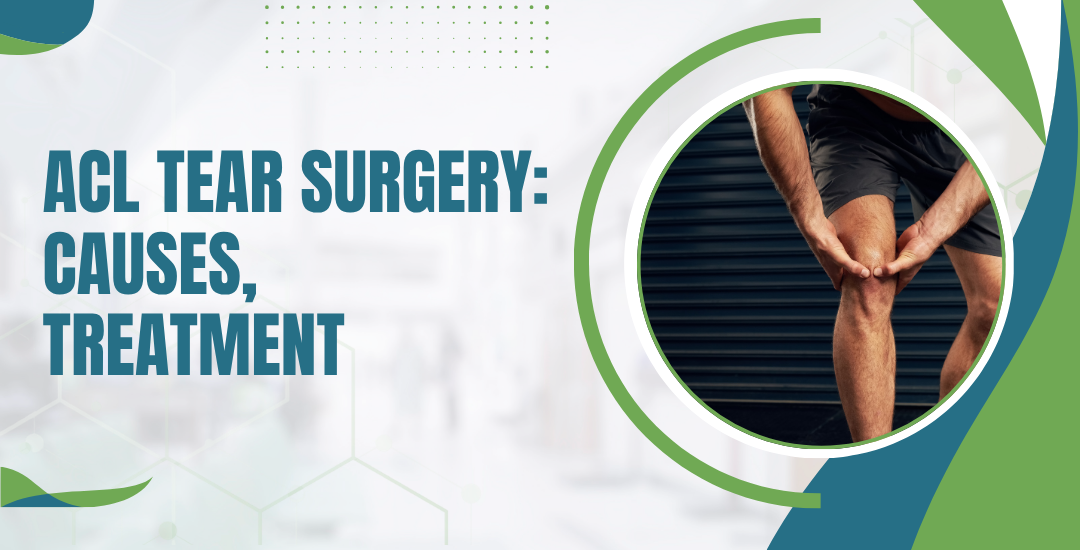
ACL tear surgery replaces the torn ligament with a graft from the hamstring or patellar tendon, placed arthroscopically through small incisions. Surgery is recommended when the ligament is fully torn, physiotherapy fails to control instability, or the patient needs to return to sport or demanding work. The procedure takes one to two hours.
According to Dr. Arpit C Dave, Arthroscopic Surgeon in Dahisar, “graft choice matters less than how well the knee is prepared before surgery, because a stiff or swollen joint going into the OR almost always slows recovery afterward.”
Still feeling your knee give way on stairs or during sport?
What Happens When the ACL Tears?
A torn ACL changes how the knee absorbs force and controls rotation almost immediately.
Sudden Pain: Most tears happen with a loud pop followed by sharp pain that makes it nearly impossible to keep bearing weight on the leg
Swelling: Fluid builds up inside the joint within hours, and that’s often the first real sign something inside the knee gave way
Instability: The knee starts to feel loose or like it might buckle, especially when turning quickly or stepping off a curb
Locking: Some patients notice catching or locking mid-movement, because a torn piece of ligament or meniscus gets caught between the joint surfaces
Not every twinge means a tear. But repeated giving-way rarely resolves on its own, and it usually gets worse before it gets better.
For patients dealing with broader knee or shoulder instability, Ligament Reconstruction Surgery covers other joint-stabilizing repairs beyond the ACL alone.
How Is ACL Tear Surgery Performed?
Surgical repair follows a fairly standard arthroscopic sequence regardless of graft type.
Arthroscopy: Two or three small incisions let a camera and instruments into the joint so open surgery isn’t needed for most cases
Graft Placement: The damaged ligament gets removed and replaced with a graft, usually taken from the patient’s own hamstring or patellar tendon
Fixation: Screws or fixation devices anchor the new graft into the bone tunnels, and that’s what lets rehab start early
Duration: The whole procedure typically wraps up in one to two hours, though complex reconstructions can run longer
Recovery timelines vary. Most patients resume daily activity within weeks, but sport-level return usually takes several months of guided rehab.
Wondering what actually separates a good outcome from a mediocre one? Our blog on choosing an arthroscopic surgeon breaks down what to look for.
Why Choose Dr. Arpit C. Dave?
Dr. Arpit C Dave is an orthopaedic and arthroscopic surgeon with over 13 years of experience treating knee ligament injuries, holding an MBBS, a Diploma in Orthopaedics, and a DNB in Orthopaedics, with fellowship training in arthroscopic surgery gained across Italy, Spain, and France.
Patients treated for ACL tears typically regain full knee stability and return to sport-level activity within six to nine months, provided rehab is followed properly. Skipping physiotherapy is the single biggest reason reconstructed knees fail.
Frequently Asked Questions
What is the success rate of ACL reconstruction surgery?
Success rates are high when paired with disciplined post-surgical rehabilitation and physiotherapy.
How long before I can walk normally after surgery?
Most patients bear weight within days and walk unaided within a few weeks.
Can a partial ACL tear heal without surgery?
Yes, partial tears often improve with physiotherapy and bracing rather than surgery.
Is arthroscopic ACL surgery painful?
Pain is manageable with medication and typically eases within the first week.