
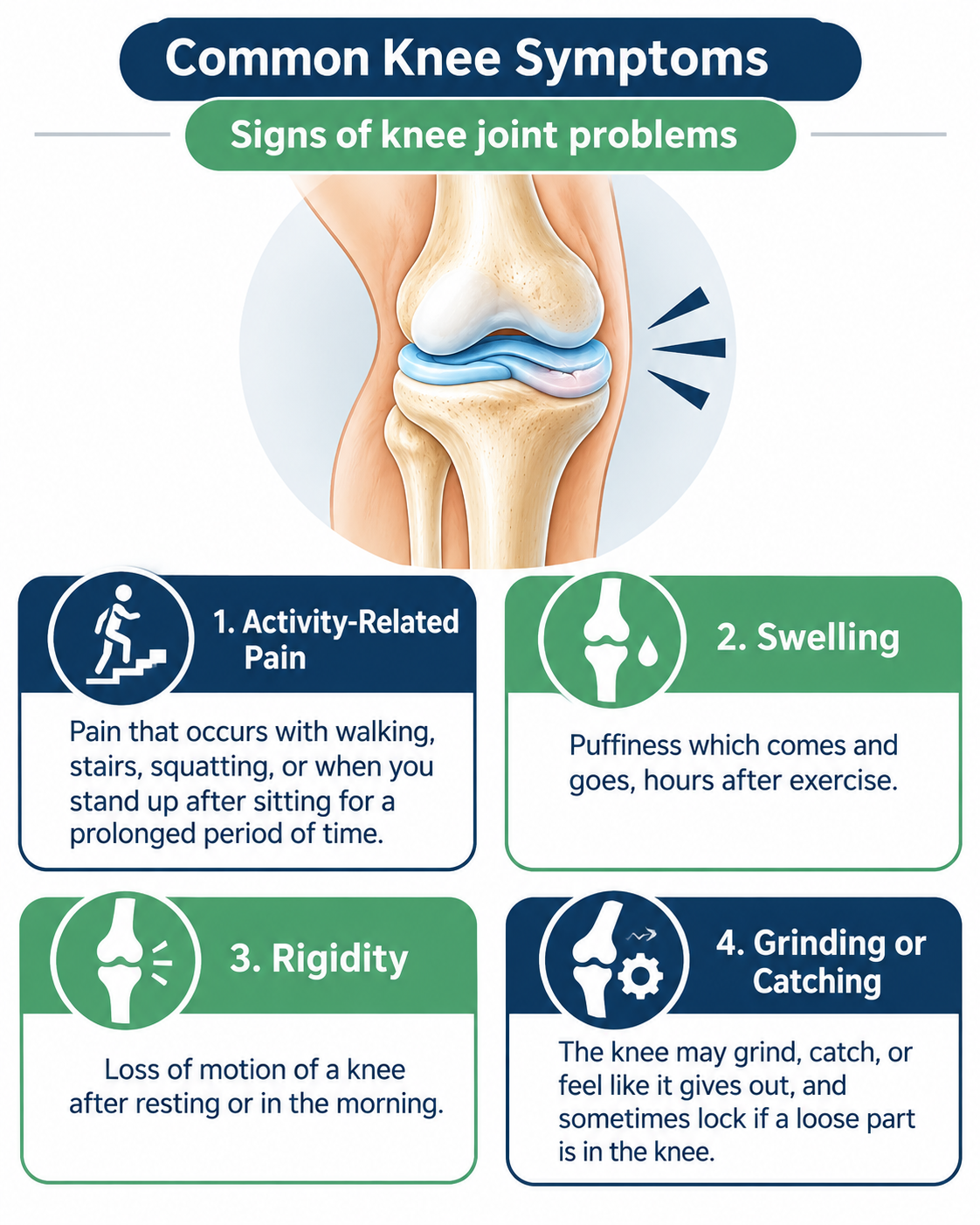
Typical symptoms of knee cartilage damage are pain in the knee during activity, swelling that occurs a few hours after activity, and stiffness, particularly after sitting. Others also report on grinding, catching or the knee giving way. Symptoms of knee cartilage damage are very likely to be subtle and easy to overlook, as early cartilage wear doesn’t result in pain. Some only realize that they have a problem when it has gotten worse.
According to Dr. Arpit Dave,an Arthroscopic Surgeon in Dahisar, Mumbai, “Cartilage has no nerve supply, so early damage can be surprisingly quiet. What patients usually notice first is an ache after activity, a knee that swells a few hours later, or a catching feeling on stairs. Because cartilage does not heal well on its own, it is worth getting a persistent knee ache checked rather than waiting it out.”
Unsure whether your knee symptoms point to cartilage damage?
What are the common symptoms of Knee Cartilage Damage:
A clinical examination and MRI can show how much cartilage is affected, which is the starting point for any cartilage treatment plan.
Torn Cartilage in the Knee – Cartilage Damage or Meniscus Tear?
There are two separate conditions often referred to as “torn cartilage in the knee” and symptoms can overlap. They generally differ in this way:
- Surface cartilage damage: A dull, activity-related ache, on-and-off swelling and a grinding feeling.
- Meniscus tear: Sudden pain to the inside or outside joint line usually after a twist with the foot on the ground.
- Locking or catching: More common with a meniscus tear, or loose body in the joint.
- Together: They may happen at the same time, such as from a twisting injury or a tear in a ligament.
A clinical examination and MRI can show how much cartilage is affected, which is the starting point for any cartilage treatment plan.
What makes the right approach to knee cartilage damage?
- The extent and severity of the trauma: A small surface-level wound is dealt with differently to a deeper wound that penetrates down to the bone.
- Damage in a weight-bearing area causes more trouble (location in the knee).
- Activity level and age: The activity level and age of a patient may influence treatment plans.
- Other knee issues: Poor alignment, meniscus tear or a ligament injury can impact the cartilage and requires attention as well.
Frequently Asked Questions
Can knee cartilage damage heal on its own?
Yes, the damage to the cartilage in the knee can heal on its own.
Cartilage can heal to some extent. Where there is surface damage, small areas will settle with activity changes and physiotherapy but if deeper defects occur these do not regrow without treatment.
What are the ways to diagnose the damage to the cartilage of the knee?
By examining the patient clinically and by MRI (which reveals cartilage much better than an X-ray), the diagnosis of the condition was confirmed. Arthroscopy is sometimes performed to directly examine the surface of the cartilage.
What are the differences between cartilage damage and arthritis?
Arthritis develops slowly, and typically presents with a general sense of ache and stiffness, primarily in older adults. Cartilage injury frequently has a precipitating event or mechanical symptoms (catching). The two are partially overlapping and examination and imaging are necessary to distinguish the two.
When to see a doctor for knee pain?
If pain or swelling persists for more than a few weeks, or if the knee locks or gives way, or if swelling occurs after a twisting injury, see a doctor.
Disclaimer :
This article is for general information and does not replace a consultation with a qualified doctor. Symptoms and treatment vary from person to person, and individual results cannot be guaranteed. Please consult your doctor before making decisions about your treatment.