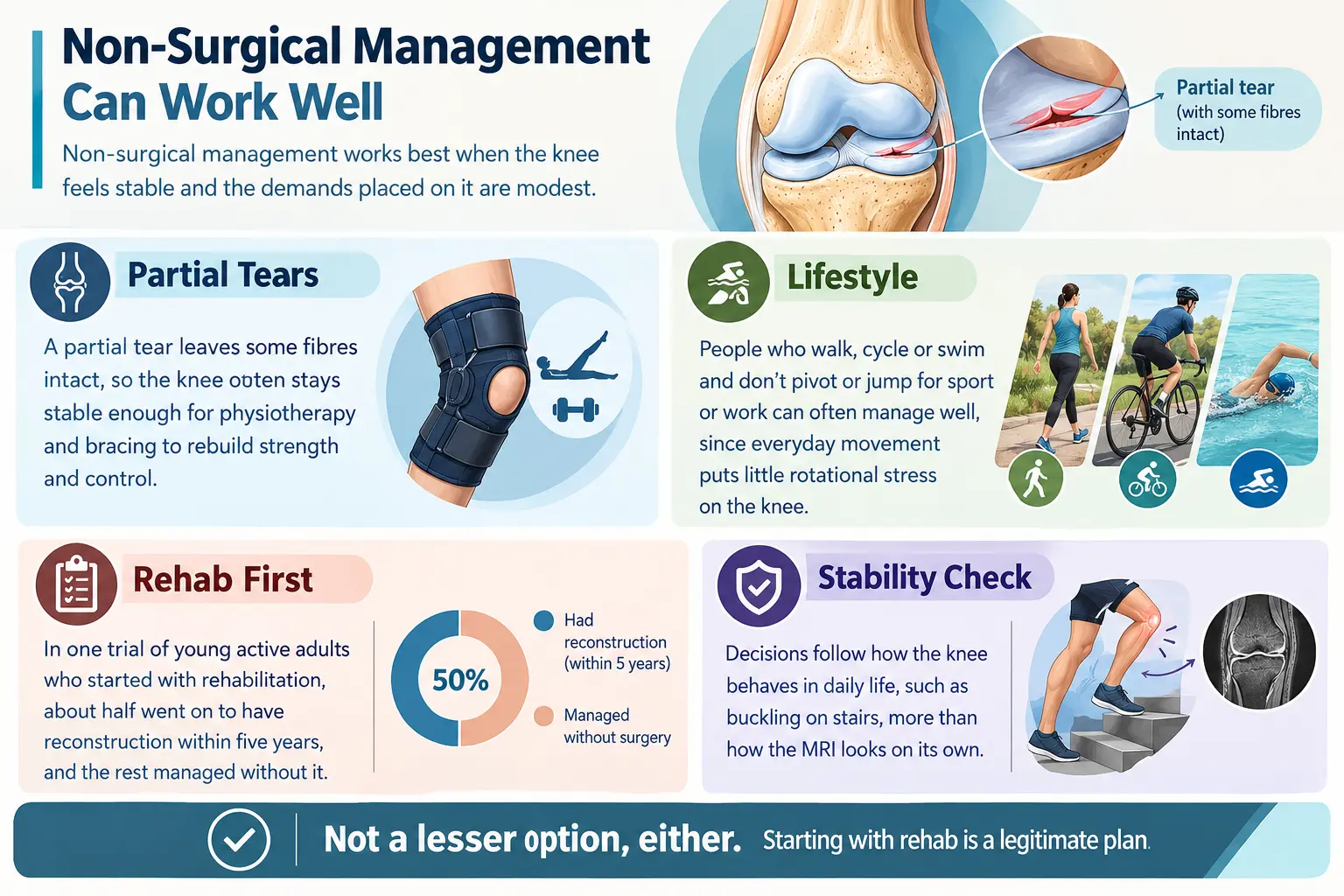
Yes, many people can live with a torn ACL without surgery, but it depends on whether the tear is partial or complete and whether the knee stays stable. Partial tears and low-demand lifestyles often do well with physiotherapy alone, while complete tears in active people frequently lead to repeated giving way. A randomized trial in young active adults found that starting with rehabilitation gave results similar to early surgery at five years.
According to Dr. Arpit C Dave, Arthroscopic Surgeon in Dahisar, “the real question isn’t whether you can live without an ACL; it’s whether your knee stays stable when you pivot, twist or step off a curb.”
Knee giving way even though the swelling has settled?
When Can a Torn ACL Be Managed Without Surgery?
Instability often tears the meniscus too, and Meniscus Tear Treatment covers that side of the knee.
What Are the Risks of Living With a Torn ACL?
The main risk is repeated giving way, because every episode can injure structures the ACL was protecting.
Giving Way: The knee buckles during turning, on stairs or on uneven ground, and each slip, even a minor one, risks another injury inside the joint.
Meniscus: A loose knee lets the thigh and shin bones shift abnormally, which can tear the meniscus over time, and ACL tears often come with a meniscus injury already.
Cartilage: Because cartilage has no blood supply, damage from repeated abnormal movement is hard to reverse and can slowly progress.
Arthritis: An anterior cruciate ligament-injured knee carries a higher chance of early osteoarthritis, and while reconstruction doesn’t remove that risk, a stable, strong knee helps protect the joint.
Small slips add up. And the knee that feels fine on a flat road is often the one that fails on an uneven footpath.
Joint surface wear after instability is explained in a separate read on cartilage treatment.
When Is ACL Surgery the Better Choice?
Surgery becomes the stronger option when the knee stays unstable or the demands on it can’t be reduced.
Instability: A complete tear with repeated giving way in everyday life, despite good physiotherapy, is the clearest sign that the ligament isn’t doing its job.
Sport: Football, basketball, badminton and other pivoting sports put the knee through sudden twists, so athletes who want to return at that level are usually advised to reconstruct.
Other Injuries: A tear that comes with a repairable meniscus injury or another ligament injury often tips the decision toward surgery, because fixing everything in one sitting protects the repair.
Work Demands: Jobs that involve climbing, carrying loads or uneven terrain leave little room for a loose knee, so these patients often choose surgery for safety as well as sport.
No rush either way. But a calm, strong knee tends to do better after surgery, so rehab usually comes first.
Ligament Reconstruction Surgery covers the wider options for unstable knees, and this read on arthroscopic surgery explains how to choose a surgeon.
Key Takeaways
- Many people can live with a torn ACL without surgery, especially with a partial tear, a stable knee and modest activity demands.
- In a randomized trial of young active adults, about half who started with rehab went on to have reconstruction within five years.
- The main risk is repeated giving way, which can injure the meniscus and cartilage and may raise the chance of early arthritis.
- Surgery is usually the better choice for complete tears with ongoing instability, pivoting sport, physically demanding work or other injuries needing repair.
- Rehab first is a legitimate plan, but the knee should be reassessed if it keeps buckling.
Frequently Asked Questions
Can a torn ACL heal without surgery?
Partial tears often improve with rehab, while complete tears heal less predictably.
How long should I try physiotherapy before deciding on surgery?
Most surgeons reassess after a few months of structured rehab, based on stability.
Is it safe to play sport with a torn ACL?
Pivoting sports are risky without a stable knee, because giving way can injure the meniscus.
What signs show a torn ACL needs surgery?
Repeated giving way, swelling after activity, or inability to return to sport despite rehab.
Disclaimer :
This blog is for educational and informational purposes only and should not be considered professional advice.