
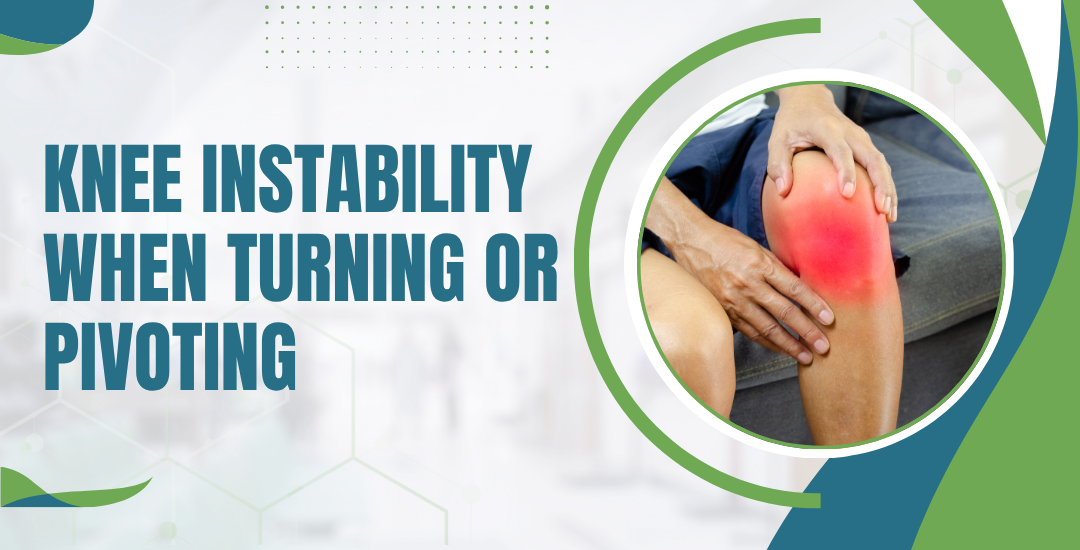
Knee instability during twisting or pivoting usually means the anterior cruciate ligament or meniscus isn’t controlling rotation properly. Straight-line walking rarely causes symptoms because that motion doesn’t test rotational stability the way a sudden turn does. A torn or lax ligament lets the femur and tibia shift out of alignment mid-rotation, producing the classic give-way or buckling sensation, while a torn meniscus can cause similar catching or locking when it gets caught between joint surfaces.
According to Dr. Arpit C Dave, Arthroscopic Surgeon in Dahisar, “A knee that only gives way on a pivot and feels fine walking straight is telling you the rotational control is gone, not the whole joint.”
Knee buckling every time you change direction?
What Causes Knee Instability When Pivoting?
A handful of specific structures are responsible for controlling rotation, and damage to any one of them changes how the knee behaves under a twist.
ACL tear: The anterior cruciate ligament is the primary rotational stabiliser of the knee, so when it’s torn, even partially, the tibia can shift forward and rotate excessively the moment you plant your foot and turn.
Meniscus tear: A torn meniscus can flip or fold into the joint space during rotation, and that mechanical block is what people often describe as the knee catching or momentarily locking mid pivot.
Patellar instability: If the kneecap tracks poorly or has a history of dislocation, twisting movements can nudge it out of its groove just enough to create a genuine feeling of the whole knee giving way.
Chronic laxity: Old, untreated ligament injuries can stretch the surrounding capsule over time, so even without a fresh tear the joint develops a subtle looseness that only becomes obvious under rotational load.
Because these causes overlap so closely in symptoms, a clinical exam combined with MRI is usually needed to pinpoint the actual source. Persistent catching or locking during movement often points toward a meniscus tear that needs direct evaluation.
How Is Pivot Related Knee Instability Treated?
Treatment depends heavily on which structure is failing and how much that instability is limiting daily movement.
Physiotherapy: Targeted strengthening of the quadriceps, hamstrings and hip stabilisers can improve dynamic knee control enough to offset mild laxity, and for a lot of lower demand patients this alone restores confidence in the joint.
Bracing: A functional knee brace limits excessive rotation during activity, which works reasonably well as a short term measure or for patients not yet ready for surgery.
Ligament reconstruction: When imaging confirms a complete ACL tear in an active or young patient, reconstructing the ligament with a graft is usually the only way to restore genuine rotational stability rather than just managing symptoms around it.
Cartilage preservation: Where repeated instability has already damaged the joint surface, procedures like cartilage treatment become necessary to stop the problem progressing toward early arthritis.
So the right path forward depends on whether you’re managing a soft tissue tear or preventing longer term joint damage, and that distinction changes everything about the plan. If your knee has also been locking up while walking, that’s a related pattern worth ruling out too.
Why Choose Dr. Arpit C. Dave?
Dr. Arpit C Dave is a specialist orthopaedic and arthroscopic surgeon with over 13 years of experience and more than 6000 surgeries performed, trained across Italy, Spain, France and Belgium.
Patients treated for ACL or meniscus related instability typically return to pivoting sports within four to six months of surgery when they follow a structured rehab plan. Ignoring recurring instability usually just adds more cartilage damage to the list.
Frequently Asked Questions
Can knee instability from pivoting heal without surgery?
Mild cases improve with physiotherapy and bracing, but full ligament tears usually need repair.
Is a locking knee always a meniscus tear?
Often, though loose cartilage fragments or an ACL injury can cause similar locking.
How long does ACL reconstruction recovery take?
Most patients return to pivoting sports within four to six months of surgery.
When should I get knee instability checked?
If your knee gives way more than once during normal daily activity.