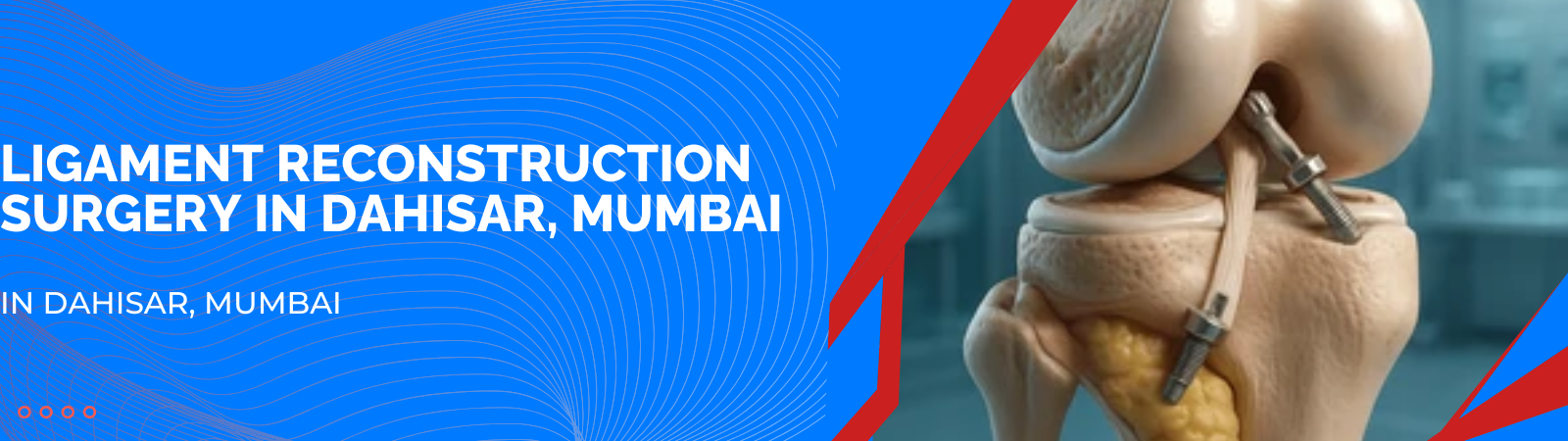
Ligament Reconstruction Surgery in Dahisar, Mumbai
Quick Answer: What Is Ligament Reconstruction Surgery? Ligament reconstruction surgery rebuilds a badly torn ligament using a graft, so the joint becomes stable again. Surgeons use it for the knee, ankle, shoulder, elbow, wrist, or thumb. In most cases, it is done arthroscopically through small cuts. In Dahisar, Mumbai, Dr. Arpit C. Dave offers ligament tear surgery and reconstruction, along with guided physiotherapy and a steady return to activity.
Key Takeaways
- Restores stability in injured joints.
- Used when ligaments are badly torn.
- Often performed arthroscopically.
- Treats knee, ankle, shoulder, elbow, wrist, and thumb injuries.
- Recovery involves physiotherapy and a gradual return to activity.
What Is a Ligament Injury?
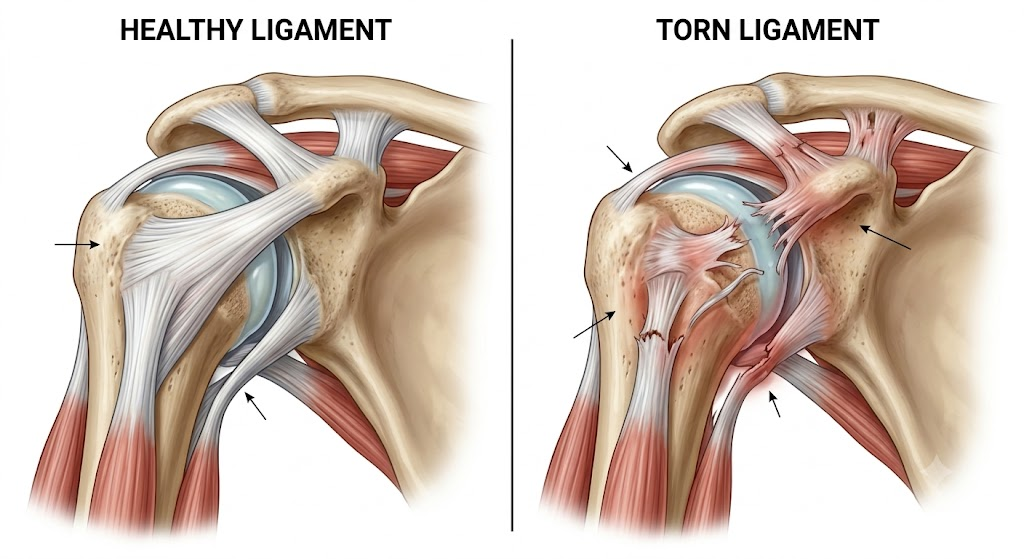
Ligaments are strong bands of tissue that connect one bone to another. They hold a joint together and keep it stable. As a result, your bones move in a smooth and controlled way.
A ligament injury happens when this tissue is stretched too far or torn. Some tears are partial, where only a few fibres are damaged. Others are complete, where the ligament snaps fully. When a major ligament tears, the joint can feel loose or weak. Often, it may also give way during normal movement.
Common Causes of Ligament Injuries
- Sports injuries, especially in contact and pivoting sports
- Falls onto an outstretched hand, knee, or shoulder
- Road traffic accidents
- Twisting injuries of the knee or ankle
- Recurrent dislocations of a joint
Signs You May Need Ligament Reconstruction Surgery
Some ligament injuries settle with simple care. Others send clear warning signs that the joint is no longer stable. Watch for these symptoms, especially after a sports injury, a fall, or an accident:
The joint feels loose, wobbly, or like it may give way
Repeated swelling after activity
Pain that returns each time you load the joint
A feeling of locking, catching, or shifting inside the joint
Weak grip, or trouble walking, running, or lifting
The joint has dislocated more than once
If these signs continue for weeks, do not ignore them. Early review by a specialist protects the joint and keeps your treatment options open.
Why Do Some Ligament Tears Need Reconstruction Surgery?
Not every ligament injury needs surgery. In fact, ligament injury treatment often starts with rest, bracing, and physiotherapy. However, some tears will not fully recover this way. In these cases, reconstruction helps protect the joint. Doctors usually consider surgery for these reasons:
Complete tears rarely heal correctly on their own
The joint stays unstable during daily activities
The joint keeps giving way
An unstable joint raises the risk of cartilage damage
There is a higher long-term risk of arthritis
Sports performance and confidence drop
Over time, an unstable joint also strains nearby tissues. Because of this, related problems sometimes need care too. For example, a patient may also need meniscus tear treatment or cartilage treatment alongside ligament surgery.
Can a torn ligament heal without surgery? Mild or partial tears often heal with rest, bracing, and physiotherapy. A complete tear, though, usually does not regain full strength on its own. If the joint keeps giving way or feels loose during sport, you may need reconstruction. Therefore, a clinical exam and an MRI help decide the right treatment for you.
Experiencing Joint Instability or Repeated Ligament Injuries? Consult Dr. Arpit C. Dave in Dahisar, Mumbai to find out whether ligament reconstruction is right for you.
How Are Ligament Injuries Diagnosed?
Accurate diagnosis guides the whole treatment plan. So before any surgery is discussed, Dr. Arpit C. Dave checks the joint carefully and confirms the injury with imaging.
Clinical Examination
First, the surgeon asks how the injury happened. Next, he checks the joint for swelling, tenderness, and movement. He also performs gentle stability tests. These tests show whether a ligament is loose or fully torn.
Imaging Tests
Imaging then confirms the findings. An X-ray rules out a fracture, while an MRI shows the soft tissues in detail. In short, the MRI reveals which ligament is torn and whether the cartilage or meniscus is also damaged.
Do I need an MRI for a ligament injury? Not always, but an MRI helps in most moderate to severe cases. It shows the exact ligament that is torn and checks for damage to nearby cartilage or the meniscus. As a result, your surgeon can plan the right treatment and avoid surprises during surgery. A simple X-ray, by contrast, mainly rules out a broken bone.
Non-Surgical Treatment: When Surgery Can Be Avoided
Surgery is not always the first step. Many partial tears and mild injuries improve well without an operation. In these cases, the goal is to calm the joint and rebuild strength.
Common non-surgical options include:
Rest, ice, and activity changes in the early days
A brace or support to steady the joint
A guided physiotherapy programme to rebuild strength and balance
Pain relief as advised by your doctor
What Is Ligament Reconstruction Surgery?
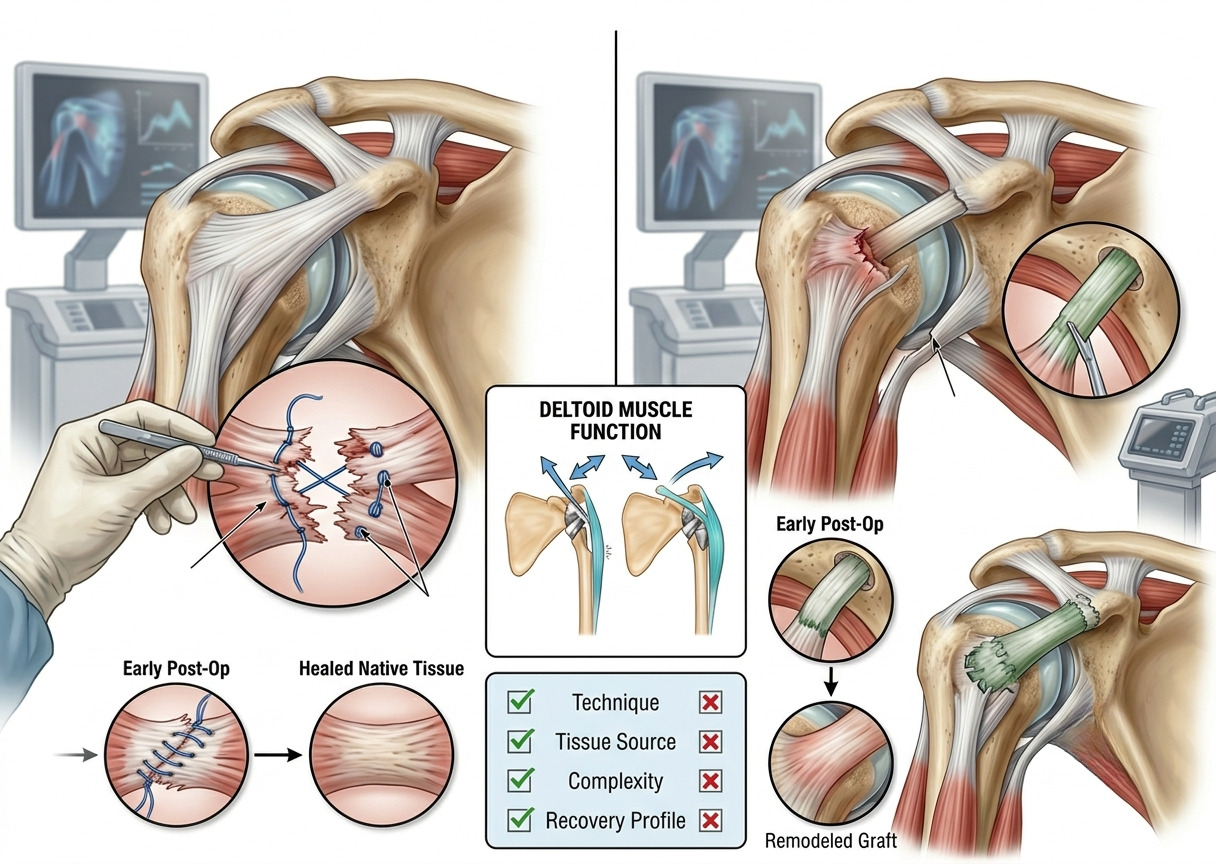
Ligament reconstruction surgery rebuilds a torn ligament, so the joint works well again. Importantly, it is not the same as a simple repair.
In a repair, the surgeon stitches the existing torn ligament back together. This works best when the tissue is still healthy. In a reconstruction, however, the damaged ligament is replaced with a graft. A graft is a strong piece of tissue, taken either from your own body or from a tissue source. For severe or complete tears, reconstruction is usually the better choice.
The approach also depends on the joint. Sometimes the surgery is done arthroscopically through small keyhole cuts. At other times, an open procedure is needed for wider access.
| Ligament Repair | Ligament Reconstruction |
| Repairs the existing ligament | Replaces the damaged ligament |
| Suitable for select tears | Suitable for severe tears |
| Limited graft use | Often uses graft tissue |
| Less common for complete ruptures | Common for complete ruptures |
Types of Grafts Used in Ligament Reconstruction
A graft is the new tissue used to rebuild the torn ligament. The right choice depends on the joint, your age, and your activity goals. Broadly, there are two main types.
|
Graft Type |
What It Means |
|
Autograft |
Tissue taken from your own body, such as a tendon near the joint |
|
Allograft |
Tissue from a screened and prepared donor source |
Both options have a strong track record. An autograft uses your own tissue, so it heals predictably and suits active patients. An allograft, meanwhile, avoids a second surgical site and can shorten the procedure. During planning, your surgeon explains which graft fits your case and why.
Which graft is best for ligament reconstruction? There is no single best graft for everyone. An autograft, made from your own tissue, is often chosen for young and active patients because it heals reliably. An allograft can be a good option when a second incision is best avoided, or when several ligaments need treatment. In the end, the choice depends on the joint, your age, and your activity goals.
Which Ligament Injuries Can Be Treated With Reconstruction Surgery?
Reconstruction is not limited to one joint. In fact, it can treat several joints, and each one has its own ligaments and surgical approach.
Knee Ligament Reconstruction
The knee has several ligaments that may need reconstruction. The ACL is the most well known. For ACL-specific care, please see our dedicated ACL tear surgery page. You can also read about common knee ligament injuries from the AAOS.
Knee procedures treated:
- PCL reconstruction surgery (posterior cruciate ligament)
- MCL reconstruction surgery (medial collateral ligament)
- LCL reconstruction surgery (lateral collateral ligament)
- MPFL reconstruction for patellar instability treatment
- PLC reconstruction for a posterolateral corner injury
- Multi-ligament knee reconstruction
Ankle Ligament Reconstruction
Repeated sprains or a bad twisting injury can leave the ankle unstable. In such cases, ankle reconstruction rebuilds the torn outer ligaments. As a result, balance and confident walking improve.
Ankle procedures treated:
- Lateral ankle ligament reconstruction
- ATFL (anterior talofibular ligament) reconstruction
- Modified Brostrom repair
- Brostrom–Gould reconstruction
Shoulder Ligament Reconstruction
Shoulder injuries often follow a fall or a contact sport. They can lead to instability or an AC joint injury. Reconstruction then restores the joint to its normal, stable position. For repeated dislocations, you can also read about shoulder dislocation treatment. Likewise, for linked tendon damage, see rotator cuff repair.
Shoulder procedures treated:
- AC ligament reconstruction
- AC joint reconstruction
- Coracoclavicular ligament reconstruction
- Weaver–Dunn reconstruction
Elbow Ligament Reconstruction
Elbow ligament damage is common after throwing sports, trauma, or instability. The inner and outer elbow ligaments can both be rebuilt. Together, these repairs restore stable, pain-free movement.
Elbow procedures treated:
- UCL reconstruction (often called Tommy John surgery)
- Lateral ulnar collateral ligament reconstruction
- Ulnar collateral ligament repair
Wrist and Thumb Ligament Reconstruction
Wrist and thumb injuries can weaken your grip and hand stability. Reconstruction brings back pinch strength, grip, and confident wrist movement.
Wrist and thumb procedures treated:
- Thumb UCL reconstruction
- Scapholunate (SL) ligament reconstruction
- CMC ligament reconstruction
- Wrist ligament reconstruction surgery
Preparing for Your Ligament Reconstruction Surgery
Good preparation makes surgery smoother and recovery faster. Before the procedure, your team guides you through a few simple steps:
Blood tests and a fitness check before surgery
Stopping certain medicines if your doctor advises it
Pre-surgery physiotherapy to strengthen the joint, sometimes called prehab
Arranging help at home for the first few days
Fasting for a set time before the operation
In addition, this is a good time to ask questions. Understanding the plan helps you feel calm and confident on the day.
Anaesthesia Used During Surgery
Ligament reconstruction is done under anaesthesia, so you feel no pain during the procedure. Depending on the joint, this may be a general anaesthetic or a regional block. Your anaesthetist chooses the safest option for you and explains it beforehand.
How Is Ligament Reconstruction Surgery Performed?
Every case is planned on its own. Still, the surgery usually follows these steps:
1. Clinical examination —
First, the surgeon checks the joint for stability, swelling, and movement.
2. MRI and imaging —
Next, an MRI confirms which ligament is torn. It also shows any cartilage or meniscus damage.
3. Surgical planning —
Then, a plan is built around the joint, the tear, and your activity goals.
4. Arthroscopic evaluation —
During surgery, a small camera confirms the damage inside the joint.
5. Graft selection —
After that, a suitable graft is prepared to rebuild the ligament.
6. Reconstruction —
The graft is placed to follow the natural path of the original ligament.
7. Fixation —
Modern implants or anchors then hold the graft firmly so it can heal.
8. Closure and recovery —
Finally, the cuts are closed and your recovery plan begins.
How long does ligament reconstruction surgery take? Most procedures take about 1 to 2 hours. The time depends on the joint and on how many ligaments need treatment. Multi-ligament or complex cases can take longer. Your surgeon confirms the exact duration during planning, after the exam and MRI.
Want to Understand Your Surgical Options? Book a consultation with Dr. Arpit C. Dave for a full evaluation and a personalized plan.
Arthroscopic Ligament Reconstruction
Arthroscopy is a minimally invasive method. The surgeon uses a small camera and fine tools through tiny cuts. As a result, the joint is treated with great precision. Many reconstructions can be done this way.
Here are the main benefits of arthroscopic reconstruction:
Smaller cuts and less scarring
A brace or support to steady the joint
Less soft tissue damage
Lower infection risk than open surgery
Is arthroscopic ligament reconstruction safe? Yes. When an experienced surgeon performs it, the technique is safe and well proven. Because the cuts are small, there is less tissue damage and a lower infection risk. Recovery is often quicker too. As with any surgery, some risks remain, so your surgeon will explain them first.
Recovery After Ligament Reconstruction Surgery
Recovery is gradual. It depends on the joint, the type of injury, and how closely you follow the rehab plan. In general, recovery moves through these stages:
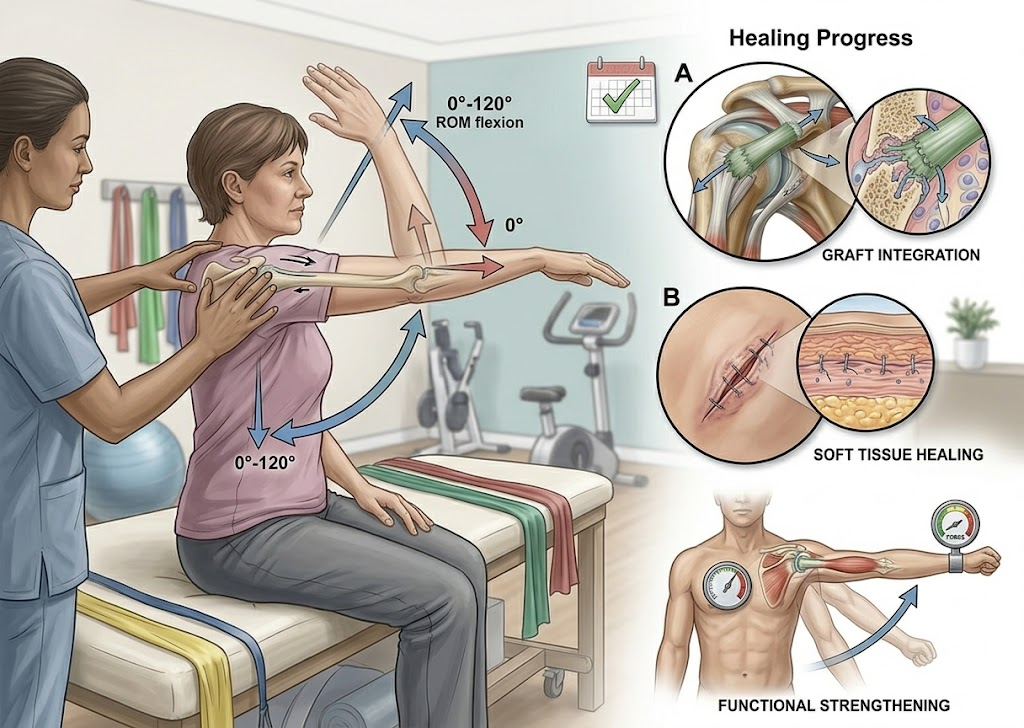
Immediate recovery:
Rest, swelling control, and a brace or support to protect the joint.
First 2 weeks:
Gentle movement, wound care, and basic physiotherapy exercises.
Weeks 2–6:
Better range of motion and more weight-bearing or use of the joint.
Months 2–3:
Strength training and harder rehab.
Return to sports:
Sport-specific drills and a staged return once the joint feels strong.
|
Recovery Phase |
Timeline |
|
Initial healing |
2–6 weeks |
|
Walking recovery |
2–8 weeks |
|
Strength training |
6–12 weeks |
|
Sports-specific rehab |
3–6 months |
|
Full sports return |
6–12 months |
Physiotherapy is one of the biggest keys to a good result. Skipping it can slow healing and raise the risk of re-injury. To understand why, read our guide on what happens if you skip physiotherapy after arthroscopic surgery.
When can I walk after ligament reconstruction? Many patients walk with support, such as crutches or a brace, within a few days. Comfortable walking without support usually returns over 2 to 8 weeks. Of course, this depends on the joint and the injury. Your surgeon and physiotherapist will guide how much weight you can put on it.
When can I drive? Driving is usually fine once you control the joint well, stop strong pain medicine, and can react safely in an emergency. For many lower-limb surgeries, this takes around 4 to 6 weeks. Upper-limb cases may allow an earlier return. Even so, always check with your surgeon first.
When can I return to sports? Return to sport is gradual. It depends on the ligament, the graft, and your rehab progress. Light activity may start within a few months. Full sport-specific return, however, often takes 6 to 12 months. Going back too soon raises the re-injury risk, so wait for your surgeon’s clearance.
Physiotherapy After Ligament Reconstruction, Stage by Stage
Physiotherapy is where most of your recovery happens. It follows a steady plan, and each stage builds on the last. Although timelines vary by joint, the path usually looks like this:
Recovery Timeline
Early stage (weeks 0–2):
Gentle movement, swelling control, and protecting the new ligament.
Recovery stage (weeks 2–6):
Slowly restoring full range of motion and starting light strengthening.
Strengthening stage (weeks 6–12):
Building muscle strength and improving balance and control.
Functional stage (months 3–6):
Sport-like drills, agility work, and a graded return to activity.
Tips for a Faster, Safer Recovery
A few simple habits protect your result:
Attend every physiotherapy session and do your home exercises
Avoid rushing back to sport before you are cleared
Keep the wound clean and watch for signs of infection
Eat a balanced diet to support healing
Tell your surgeon early about any new pain or swelling
What Are the Risks and Complications of Ligament Reconstruction Surgery?
Reconstruction is generally safe. Like all surgery, though, it carries some risks. Knowing them helps you make an informed choice:
Infection:
Uncommon, and lowered by sterile technique and small cuts. It is treated quickly if it happens.
Joint stiffness:
Can build up if movement is delayed. For this reason, early physiotherapy matters.
Blood clots:
A small risk after lower-limb surgery. Happily, early movement helps lower it.
Graft failure:
The new ligament may stretch or fail. Usually, this links to re-injury or an early return.
Re-injury:
A treated joint can be hurt again, especially in high-demand sports.
Persistent instability:
A few patients may still feel some looseness.
Nerve or vessel injury:
Rare, since the surgeon works carefully around nearby nerves and vessels.
What Results Can You Expect After Ligament Reconstruction Surgery?
When the surgery suits the injury and the rehab is done well, most patients improve. Typically, the goals include:
Better joint stability
Better overall joint function
A return to daily activity and work
Less pain and less giving way
A return to sports for many active patients
What is the success rate of ligament reconstruction surgery? Reconstruction has good success rates for stability and a return to activity. Still, outcomes vary from person to person. Results depend on the joint, the injury, the graft, the technique, and your rehab. So instead of promising a result, your surgeon will explain the factors that shape your recovery.
Planning to Return to Sports or an Active Lifestyle? Early diagnosis and the right treatment can restore stability and improve long-term joint function.
Ligament Reconstruction for Athletes and Active People
Athletes put high demands on their joints. So for sportspeople, the goal is not only stability but also a safe return to play. A clear, staged plan makes this possible.
Return to sport is never rushed. Instead, it is earned through strength, balance, and confidence tests. For many athletes, light training begins within a few months, while full competitive play often takes 6 to 12 months. This careful approach lowers the risk of re-injury and protects your long-term performance.
When can athletes return to sport after ligament reconstruction? Most athletes return to full sport between 6 and 12 months after surgery. The exact time depends on the ligament, the graft, and how well rehabilitation goes. Before clearance, the joint must pass strength and stability checks. Returning too early is the most common cause of re-injury, so patience here truly pays off.
Ligament Reconstruction Surgery Cost in Dahisar, Mumbai
What is the cost of ligament reconstruction surgery? The cost in Dahisar, Mumbai is not fixed. It depends on the joint, the severity of the injury, and the technique used. Therefore, an accurate estimate is shared after a clinical exam and an MRI, so the plan can match your needs.
Several factors affect the ligament operation cost and the overall ligament surgery cost:
The joint being treated
A single vs a multi-ligament injury
Arthroscopic vs open surgery
The graft chosen
Implants and fixation devices
The length of hospital stay
Rehabilitation and physiotherapy
First 2 weeks:
Gentle movement, wound care, and basic physiotherapy exercises.
|
Cost Factor |
Influence |
|
Joint involved |
Moderate to High |
|
Severity of injury |
High |
|
Arthroscopic procedure |
Moderate |
|
Graft type |
Moderate |
|
Implants |
Moderate to High |
|
Rehabilitation |
Moderate |
Planning to Return to Sports or an Active Lifestyle? Early diagnosis and the right treatment can restore stability and improve long-term joint function.
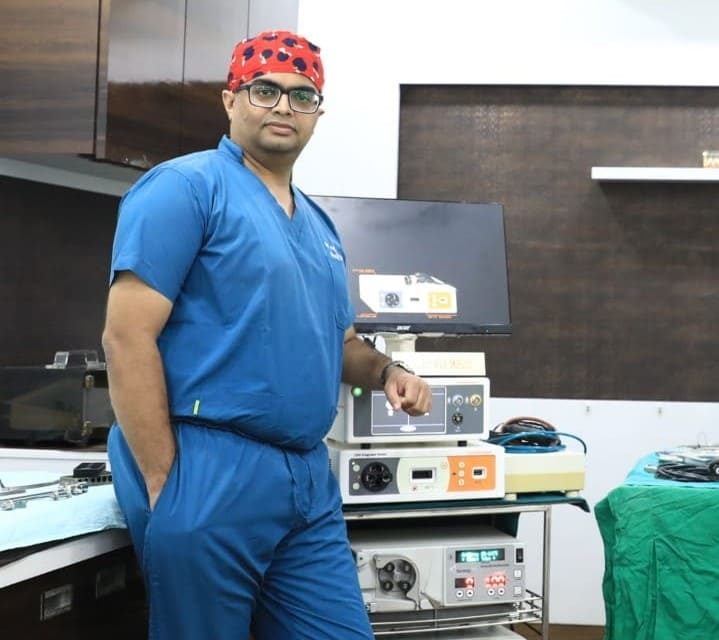
Why Choose Dr. Arpit C. Dave for Ligament Reconstruction Surgery in Dahisar, Mumbai?
Dr. Arpit C. Dave is an experienced arthroscopic surgeon in Dahisar, Mumbai, and a trusted ligament surgeon in Mumbai. As an orthopedic surgeon for ligament injury, he focuses on sports injuries and joint instability. Patients choose him for several reasons:
Expertise in sports injury treatment: Focused experience with ligament and joint injuries.
Arthroscopic techniques: Minimally invasive methods used wherever they suit the case.
Personalized planning: Each plan fits the joint, the injury, and your goals.
Full rehab guidance: Clear physiotherapy and recovery support after surgery.
Patient-centered care: Honest advice, plain language, and realistic expectations.
So if you are looking for the best ligament reconstruction surgeon in Mumbai, Dr. Arpit C. Dave can guide you through your options with clarity and care.
Book a Consultation With Dr. Arpit C. Dave If you have joint instability, repeated injuries, or ongoing ligament symptoms, book a consultation to discuss your options
Google Reviews


Frequently Asked Questions
Can a torn ligament heal naturally?
Minor or partial ligament tears may heal with rest, bracing, and physiotherapy. However, complete ligament tears often do not regain normal strength or stability on their own. If the joint continues to feel unstable, ligament reconstruction surgery may be recommended to restore function and prevent further damage.
Is ligament reconstruction a major surgery?
Ligament reconstruction is a specialized orthopedic procedure performed to restore stability to an injured joint. Many ligament reconstructions can be performed arthroscopically through small incisions, which may reduce tissue damage and support faster recovery compared to traditional open surgery.
How long does recovery take after ligament reconstruction surgery?
Recovery depends on the ligament involved, the severity of the injury, and the patient’s rehabilitation progress. Most patients gradually return to daily activities within a few weeks, while higher-level sports and demanding physical activities may require several months of structured physiotherapy and recovery.
What happens if a ligament tear is left untreated?
A severe ligament tear can lead to ongoing joint instability, repeated injuries, cartilage damage, and reduced physical activity. Over time, an unstable joint may also increase the risk of early joint degeneration and arthritis. Early evaluation helps determine the most appropriate treatment plan.
What is the cost of ligament reconstruction surgery in Dahisar, Mumbai?
The cost of ligament reconstruction surgery varies based on factors such as the joint being treated, the complexity of the injury, the surgical technique used, graft selection, implants, hospital stay, and rehabilitation requirements. A detailed consultation and clinical assessment are necessary to provide an accurate treatment estimate.